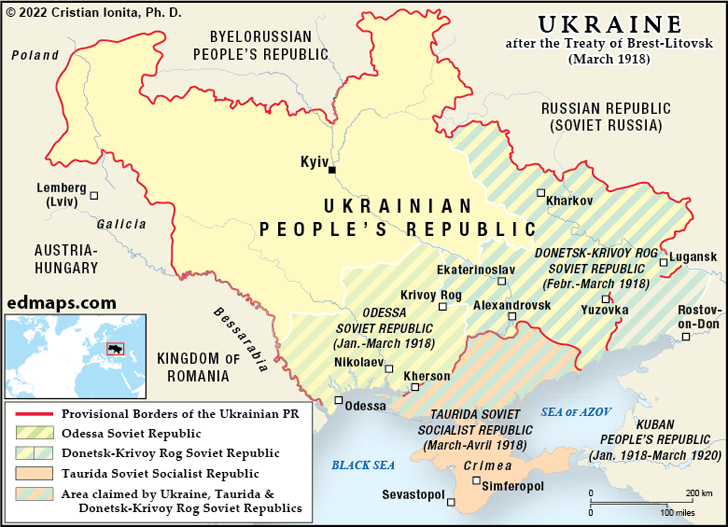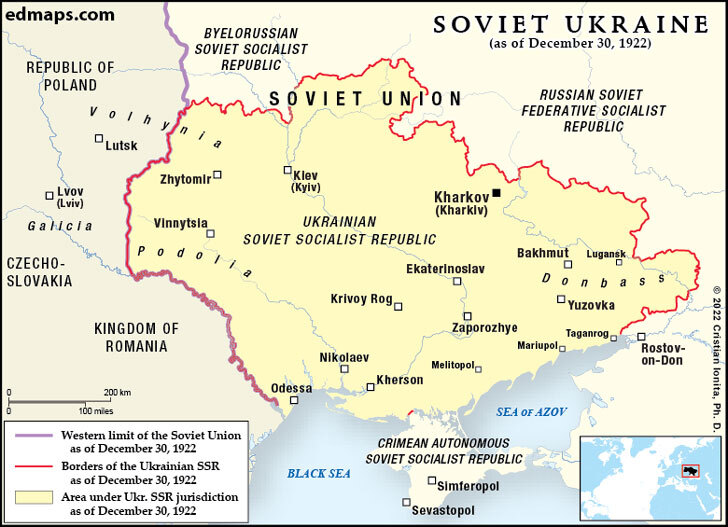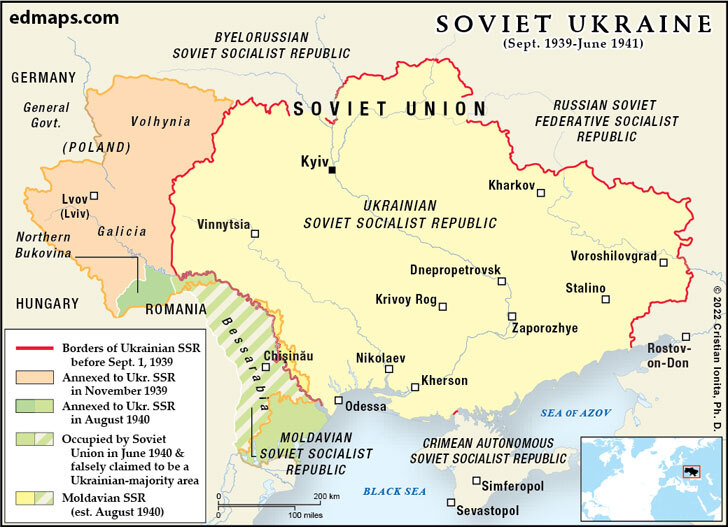
In April 2014, amid Russia's annexation of Crimea and the outbreak of war in eastern Ukraine, Vladimir Putin explicitly revived the historical term "Novorossiya" to challenge Ukraine's territorial integrity. Speaking to Russian citizens, Putin declared that vast swathes of southern and eastern Ukraine—Kharkov (Kharkiv), Lugansk (Luhansk), Donetsk, Kherson, Nikolaev (Mykolaiv), and Odessa (Odessa)—were not part of Ukraine in tsarist times: "these territories were given to Ukraine in the 1920s by the Soviet Government." This statement crystallized a territorial claim grounded in imperial nostalgia and historical grievance.
Putin elaborated this ideology most comprehensively in his July 12, 2021 essay "On the Historical Unity of Russians and Ukrainians." This 5,000-word manifesto became a foundational text for justifying Russian aggression, arguing that Russians and Ukrainians constitute "one people" artificially divided by malicious external forces and Bolshevik nationality policies. Putin claimed that Lenin and the Bolsheviks had arbitrarily "gifted" historically Russian lands to Soviet Ukraine during the 1920s, creating borders that lacked historical or moral legitimacy. These administrative decisions, in Putin's narrative, severed territories rightfully belonging to Russia based on imperial conquest, Russian settlement, and cultural affinity.
For Putin and Russian nationalist ideologues, Novorossiya represents lands essential to Russian greatness and security. These territories provided access to the Black Sea, controlled vital agricultural and industrial resources, and housed millions of Russian-speakers whose protection Moscow claimed as a sacred duty. The argument positioned Russia as rectifying historical wrongs and reuniting the Russian world (Russkiy mir)—a civilizational space transcending current state boundaries.
This imperial vision portrayed the reconquest of Novorossiya as defensive rather than aggressive. Proponents argued that Western expansion and Ukrainian nationalism threatened Russian-speakers in these regions, necessitating Moscow's intervention. They invoked tsarist-era sacrifices—blood spilled conquering the steppe from Ottomans and Tatars—to assert Russia's permanent claim. In their telling, Catherine the Great's victories, Potemkin's city-building, and Russian settlers' toil created an inalienable patrimony that no Soviet decree could legitimately transfer.
The Novorossiya concept served multiple purposes for Russia's leadership: it provided historical cover for territorial aggression, appealed to imperial nostalgia among Russians, and framed Ukraine's resistance as illegitimate separatism rather than national self-defense. However, this narrative distorts complex historical realities, ignores Ukrainian national identity and self-determination, dismisses the legitimacy of internationally recognized borders, and serves as justification for aggression that has caused enormous human suffering.